
Nabel Solutions Get in touch

The Xtractor Series

Capture the serial. Certify the destruction. Never touch a network.

Scanning appliances for ITAD and secure-destruction operators. Devices are photographed, their identifiers extracted, and the chain-of-custody record is written as the operator confirms each one — entirely on hardware that stays offline.

Operator confirms
Every single record
Connectivity
Disabled on production units
Certificate
Carries your branding

Why operators come to us

The record is the product

Your customer is not buying destruction. They are buying evidence that destruction happened, to a specific device, under a chain of custody that survives their auditor. Everything upstream of that record exists to make it trustworthy.

Keying serials by hand is the bottleneck

Reading a label by eye and typing it into a spreadsheet is slow, and it is the step where transposed characters enter the record. Every tier in the series exists to remove that keystroke.

Labels do not cooperate

Barcodes are scratched, obscured or absent. A single label may carry a part number, a model code and a service tag alongside the serial. Reading the wrong one is worse than reading nothing.

A scanner bolted to one machine only helps at that machine

Devices get identified at intake, on a bench, in a van and at a customer site — not only at the point of destruction. The series runs on a laptop, a kiosk or a handset, with the same workflow and the same record on each.

Connected tools fail your customer's review

Clients in regulated industries increasingly cannot accept a device that talks to a cloud service. The offline posture is not something we added late — it is the starting constraint.

Three tiers

Start where your labels are

The tiers differ in how much of the label the device can read for itself. They do not differ in who has the final say — that is always the operator.

In beta with first customers

Code Xtractor

Barcode capture with an operator confirmation on every scan.

Code Xtractor is the entry point to the series. It photographs the device, extracts every barcode on the label, and presents what it found to the operator for confirmation.

What it does

  • Barcode extraction. Reads the barcode formats used on drive, module and asset labels, including the two-dimensional formats that carry built-in error correction. Multiple barcodes on one label are all extracted and shown.
  • Operator confirmation on every scan. Nothing is written to the record until a person confirms it. There is no automatic acceptance path to misconfigure.
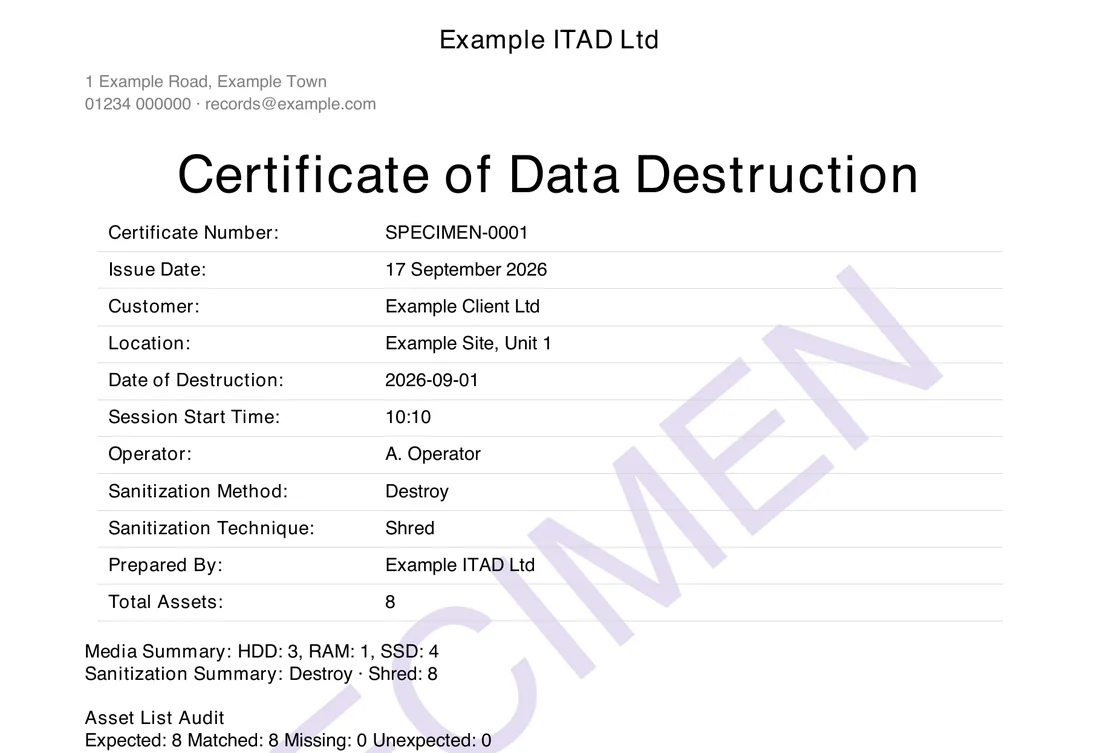
  • Session records and certificates. Each session produces a certificate of destruction and a CSV manifest, carrying your organisation's branding rather than ours.
  • Per-scan diagnostics. Timing, decode attribution and device health are recorded for every capture and can be pulled off the device for review. They are never shown to the operator mid-shift.

Where it stops

  • Does not read printed text. If a device's serial appears only in print, Code Xtractor cannot capture it — Data or Serial Xtractor is the right tier.
  • Every scan requires an operator confirmation. That is the design, not a limitation to be tuned away.
Prototype — evaluation units

Data Xtractor

Barcode capture plus on-device text extraction, with the operator choosing the identifier.

Data Xtractor adds text extraction to the barcode path. Printed labels are read on the device, and every candidate identifier it finds is offered to the operator alongside the barcode results.

What it does

  • Everything Code Xtractor does. The full barcode path, unchanged, with the same confirmation discipline.
  • On-device text extraction. Printed labels are read on the unit itself using a dedicated on-device AI processor. No image and no text is transmitted anywhere.
  • Candidate selection, not guesswork. Extracted values are presented as candidates. The operator picks the correct one. The system does not construct agreement between a barcode and a piece of text that do not actually agree.
  • Full capture evidence. The captured image, what each stage read, and the operator's decision are all retained, so any individual scan can be reconstructed later.

Where it stops

  • Prototype units are with evaluation customers. It is not yet a general-availability product.
  • Text extraction quality varies with label condition and lighting. Poor captures produce fewer candidates, not wrong ones.
In development

Serial Xtractor

Barcode, text extraction and a trained recogniser that recommends — but never confirms.

Serial Xtractor is the top of the series. On top of the barcode and text paths, a recogniser trained on real device families identifies which of the values on a label is actually the serial number.

What it does

  • Everything Data Xtractor does. The barcode and text extraction paths, with the same evidence retention.
  • Trained identification. A recogniser trained per device family distinguishes a serial number from the part numbers, model codes and service tags printed alongside it.
  • Recommend-only by design. A recommendation is presented for the operator to accept or override. It is never written to the record on its own.
  • Runs entirely on the unit. Identification happens on the device's own AI processor. No inference is performed off the unit and no training data leaves it.

Where it stops

  • In development. Not available to order, and not yet in customer evaluation.
  • Automation improves as a device family is learned. A new family starts with more operator involvement, not less.

Serial Xtractor is in development and is not available to order. We would rather tell you that here than in a sales call.

Tier × chassis

Every cell is its own build. This table shows where each one actually stands today — not where we intend it to be.

Status reflects the current build of each combination. "In development" means exactly that: not orderable, not in evaluation.
Tier LaptopOffline kioskMobile offlineBelt integration
Code Xtractor betabetain developmentroadmap
Data Xtractor in developmentprototypein developmentroadmap
Serial Xtractor in developmentin developmentin developmentroadmap

Belt integration is on the roadmap across all three tiers and is not yet shipping on any of them.

What you get regardless of which one you pick

The tiers are a capability ladder, not a feature-gating exercise. The parts that make the record trustworthy are in all of them.

How it works

Capture, extract, confirm, certify

The same four steps run on every tier and every chassis. What changes between tiers is how much the device can hand the operator at step three.

  1. Capture

    The device is photographed with camera settings the unit sets itself — exposure, focus and white balance are re-applied on every start-up so a firmware update cannot silently change what your captures look like.

  2. Extract

    Barcodes on the label are decoded. On the Data and Serial tiers, printed text is read as well. All of it happens on the unit, using its own processing hardware.

  3. Operator confirms

    What the unit found is presented as candidates. The operator picks the correct identifier, or rejects all of them and re-scans. This step cannot be skipped or automated away.

  4. Certify

    The confirmed identifier joins the session record. When the session closes you get a certificate of destruction and a CSV manifest, both carrying your organisation's branding.

The loop never completes on its own. There is no timeout that accepts a reading, and no confidence threshold that promotes a guess into a record.

A wrong serial is worse than no serial

If a record says a device was destroyed and names the wrong serial, two things are now untrue at once: a device that was destroyed is unaccounted for, and a device that still exists is recorded as gone. That failure is far more damaging than simply failing to read a label, so the whole system is built to prefer asking over guessing.

Disagreement means review

When two readings of the same label do not agree, the unit holds the device for the operator. It does not strip characters, reformat or otherwise massage one value until it matches the other.

Only serials become candidates

A label may carry a part number, a model code and a service tag. Those are extracted and shown for context, but they are never offered as the serial number.

Trained models recommend only

Where a trained recogniser is involved, its output is a recommendation for a person to accept or override. It has no route to writing a record by itself.

Every scan can be reconstructed

Months after a session, you may need to answer a precise question about a single device. The unit keeps what it takes to answer it.

  • The captured image, as the unit saw it
  • What each extraction stage read, separately
  • Which candidates were offered to the operator
  • Which one the operator confirmed, and when
  • Timing and device-health diagnostics for that capture

Diagnostics are recorded for every capture, including ones that were abandoned — a capture that produced nothing is often the more interesting record.

Certificates and manifests

A session produces a certificate of destruction as a PDF, plus a CSV manifest of every device in it. Both carry your organisation's name and identity — this is your document, issued by you to your customer.

Getting records off a unit is a deliberate operator action, not a background sync. On offline chassis that means an export to removable media, initiated by the operator.

Security & compliance

Written for the person who has to approve it

If you handle devices for clients in regulated industries, someone on their side will eventually ask what this equipment does with data. This page exists so you can forward it rather than write the answer yourself.

The short version

A production unit has no network connectivity enabled, sends nothing anywhere, and holds its records until an operator deliberately exports them. There is no account to create, no service to sign into, and no component that phones home.

Offline by design

Production units ship with connectivity disabled. This is the shipped state, not a hardening step you have to remember to perform. Where a unit needs to talk to peripherals it does so over direct local connections, not a network.

No telemetry, no analytics, no phone-home

The software collects diagnostics for your benefit and writes them to the unit's own storage. Nothing is transmitted to us. We do not know how many scans you ran unless you tell us.

All processing is local

Barcode extraction, text extraction and trained identification all run on the unit's own hardware. No image, no reading and no record is sent elsewhere to be processed.

Export is a deliberate act

Records leave a unit when an operator initiates an export to removable media. There is no background sync, no scheduled upload and no automatic mount.

Encryption at rest

Production units encrypt the storage that holds captures and records, so a unit removed from your site does not become a data-disclosure incident.

A start-up self-test

Before a unit reports itself ready, it verifies its camera, extraction stages, storage and thermal state. A unit that cannot do its job says so instead of accepting scans it cannot process properly.

What an auditor can actually check

A certificate is only as good as what stands behind it. Behind each line on ours is a retained capture and a recorded human decision.

  • The image the unit captured for that device
  • What each extraction stage read from it, separately
  • The candidates offered, and the one the operator confirmed
  • The session that record belongs to, and when it was closed
  • Per-capture diagnostics, including captures that produced nothing

Questions we expect

  • Where is data stored, and in what form?
  • What leaves the device, when, and triggered by whom?
  • Can the device be made to connect to a network, and who can do that?
  • What happens to captures when a unit is decommissioned or returned?
  • What third-party components are in the software, and under what licences?

We answer these in writing, in detail, for any live evaluation. Ask and we will send the documentation rather than a brochure.

What we do not claim

Buyers in this market are used to reading certification logos that turn out to mean less than they appear to. We would rather be precise.

We hold no third-party security certification

Nabel Solutions has not been audited against a published information-security standard. If a certification is a hard requirement for your client, tell us early and we will be straight with you about the timeline.

We do not certify your destruction process

Xtractor records what was destroyed and who confirmed it. Whether your destruction method meets a given standard is a question about your equipment and process, not about this software.

Deployment

Four chassis, one workflow

A scanning station is not always a fixed bench. The series runs on whatever suits the place the work actually happens, and produces the same record on each.

Laptop

Windows, macOS or Linux with a USB document camera. The quickest way to put a station on a bench.

Runs on hardware your team already owns. Useful for lower volumes, for a second station at peak, and for evaluating a tier before committing to dedicated hardware.

Tiers:Code — betaData — in developmentSerial — in development

Offline kiosk

A dedicated single-purpose appliance with a touchscreen and document camera, locked to kiosk mode.

Purpose-built and provisioned by us. Boots straight into the scanning workflow, has no desktop to wander off into, and ships with networking disabled.

Tiers:Code — betaData — prototypeSerial — in development

Mobile offline

A hardened handset, provisioned by us and shipped locked down, for scanning away from a bench.

For collections, on-site work and audits where the device has to travel. Provisioned before it ships and locked to the scanning application.

Tiers:Code — in developmentData — in developmentSerial — in development

Belt integration

Roadmap

Conveyor integration for high-throughput lines — stop-for-capture, scan, release.

Pairs a kiosk with a conveyor and controller so devices are captured as they travel. On the roadmap; not yet shipping.

Tiers:Code — roadmapData — roadmapSerial — roadmap

Units are provisioned, not shipped as a download

On the dedicated chassis, we build the unit, install and configure the software, and lock it to the scanning workflow before it leaves us. It arrives ready to be switched on.

  • Built, configured and tested by us against the tier you have chosen
  • Connectivity disabled before shipping, with a documented path to re-enable it if you ever need to
  • Locked to the scanning application — no desktop to wander into
  • A start-up self-test that checks the camera, extraction stages, storage and temperature before the unit reports itself ready
  • Your organisation's branding applied to certificates before handover
  • An on-site handover, with your operators, on your devices

Evaluate on your own device mix. Label quality varies enormously between operators, and a demonstration on our devices tells you very little about yours. We would rather put a unit in front of your actual intake and find out together.

Ask about an evaluation

Partners & OEM

If you sell destruction equipment, this is the part your customers ask you for next

Machines destroy the device. The thing your customer has to hand their own client afterwards is a record. We build that half, and we are actively looking for manufacturing and reselling partners to carry it.

Equipment manufacturers

Offer serial capture and certificate generation alongside your machines, either as a bench-side unit or integrated with the line. Your customers get a complete answer; you get a differentiator that does not require you to build software.

Resellers & distributors

Add a hardware product to your catalogue with a clear buyer, a clear problem and a short demonstration. We provision the units; you own the customer relationship.

Service partners

If you already install, service or support equipment on ITAD sites, on-site handover and support is work you are better placed to do than we are.

We are early. Code Xtractor is in beta with its first customer. Data Xtractor is with evaluation users. Serial Xtractor is in development. We have no reseller network yet and you would be among the first.

That is a real risk for a partner and we are not going to dress it up. What we can offer in exchange is direct access to the people building the product, genuine influence over what gets built next, and terms that reflect the stage we are at rather than the stage we would like to appear to be at.

If you would rather wait until there is a track record, we understand — tell us and we will come back to you when there is one.

Questions

Answers, including the awkward ones

If your question is not here, ask it directly — we would rather answer than have you guess.

Does the device need an internet connection?

No. Production units ship with connectivity disabled and operate entirely offline. Records leave a unit when an operator deliberately exports them to removable media.

Does any of our data reach Nabel Solutions?

No. There is no telemetry and no background sync. Diagnostics are written to the unit’s own storage for your use. We do not know how many scans you have run unless you tell us.

Can the system confirm a serial without an operator?

No, and there is no configuration that enables it. Every record requires an affirmative action from the operator at the station. On the Serial tier, the trained recogniser produces a recommendation for a person to accept or override.

What happens when the device cannot read a label?

It says so and asks the operator. It will not transform, truncate or reformat one reading until it matches another. A held device is a normal outcome, not a fault.

Whose branding appears on the certificate of destruction?

Yours. The certificate is your document, issued by your organisation to your client. Our name does not appear on it.

What do we get out of a session?

A certificate of destruction as a PDF and a CSV manifest of every device in the session. Behind each line sits the captured image, what each extraction stage read, and which value the operator confirmed.

Which tier do we need?

If your labels reliably carry a readable barcode, Code Xtractor is the fastest route. If serials are often only printed, Data Xtractor adds on-device text extraction. Serial Xtractor adds trained identification of which value is the serial, and is in development.

Can we run it on hardware we already own?

On the laptop chassis, yes — Windows, macOS or Linux with a USB document camera. The kiosk and mobile chassis are provisioned by us and shipped ready to use.

Can we try it on our own devices before committing?

That is the only evaluation worth running. Label quality varies enormously between operators, so a demonstration on our devices tells you little about yours. Ask us about an evaluation unit.

How many units are in the field?

Very few. Code Xtractor is in beta with its first customer, Data Xtractor is with evaluation users, and Serial Xtractor is in development. We would rather you knew that now than found out later.

Do you hold a security certification?

Not at present. Nabel Solutions has not been audited against a published information-security standard. We answer security questionnaires in writing and in detail, and we will tell you plainly if a certification requirement is one we cannot currently meet.

What happens if a unit is returned or decommissioned?

Storage holding captures and records is encrypted on production units. We agree a decommissioning process with you before deployment rather than improvising one afterwards.

About

Nabel Solutions LLC

A small independent software studio building automation for the ITAD and secure-destruction industry.

What we do

We build the Xtractor Series — offline scanning appliances that capture device identifiers and produce the chain-of-custody records that destruction operators have to hand their own clients. The products are designed, built and provisioned by us.

We also build bespoke software and web tooling for a small number of other businesses. That work funds the product line and keeps us close to how operators actually work.

How we work

The products are opinionated in one particular way: a person confirms every record. That constraint costs throughput and we keep it anyway, because a destruction record that quietly contains the wrong serial is worse than no record at all.

We would rather tell you what a product cannot do than discover it together during an evaluation. Where this site says something is in development, it means it — you will not find a roadmap item described in the present tense anywhere on these pages.

Contact

Tell us about your line

Volumes, the device mix you handle, and what your own customers require of you. We will tell you which tier fits — including when the honest answer is that none of them do yet.

Or write to info@nabelsolutions.com directly.

What happens next

  • A person reads it — there is no auto-responder sequence
  • We reply with questions, or with a straight answer that we are not a fit
  • If it looks like a fit, we talk about putting a unit in front of your own devices

Security reviewer?

Say so in your first line and we will send the written documentation rather than a sales reply.

Emailing us puts your message in our inbox and nowhere else. This site has no contact form, no tracking and no third-party service that could see it.